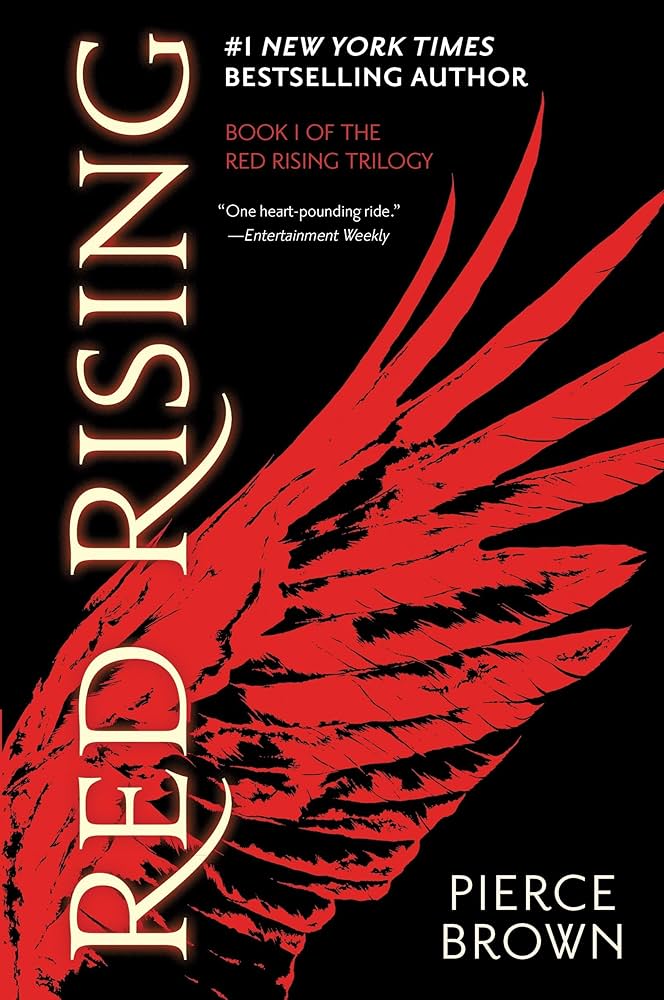
Red Rising is a 2014 sci-fi dystopia written by Pierce Brown-the first in the eponymic trilogy, although the world expands beyond. The novel follows Darrow, a Helldiver miner in the fictional city Lykos on Mars, as his life turns upside down upon losing his wife and finding out the lies that kept his community down in misery by the 'Gold' society. The series covers through his revolution to this; and Red Rising, the first book in it, is the beginning step that Darrow must take in uplifting his people.
I was recommended this book by a friend, who told me to start on it while I was calmly presiding over thoughts of Greek philosophy. And if you've read the series, you probably know the stark difference that was to meet me after that point. Pages turned, and soon I had read five chapters, and then ten. Initially it was depressing. Seeing Darrow's life in the mines was misery. However, as this turns to a completely new ordeal for him, Darrow's initial life acts as this support even for the readers to not dull over, as he often moves through this series with the faith of hope that he should become in rescuing his people from that fate. I would say, it still does not always hit, but indeed, Darrow is most charged over his wife, Eo's dream than anything else. His life mission is in a way a flux of fulfilling that dream, with the vindication of his people alongside.
It's easy to forget in a book like this, with a mission as what Darrow has, the fact that the children in the Institute, are in fact in a sandbox. Augustus tells Darrow at the end of the book of how what he saw wasn't life- how the Peerless Scarred maintained anyone from gaining too much control. But Darrow and his fellows are teenagers. And it's not an underestimation of the challenges that they had to face at the Institute: they suffered, were humiliated and lived terribly; were wronged upon in the most ghastly ways, and some died(R.I.P.(spoiler) Pax au Telemanus (if anything, to shout that name again). So, it's this weird mix: it's when a game has some element of wrong to it, and that wrong is mixed in this potion that is to teach you life-so you have to bear and fight out that poison, or live with it. But at light moments you do see how they could act as they are, boyos with purpose in their minds, Golds who are too proud.
The theme itself should have been clear, and more over, I would like to accentuate, a parallel to our own world, except with the heavy Roman influences. In most discriminatory frameworks, the first basis happens to be that of colour, and then moves onwards; the author places that notion correctly onto this hierarchial system with multiple colours from bottom(Red) to top(Gold). Even on an advocacy of meritocracy, we find the worlds Darrow passes to be still rigged; and that's when you see how the powerful indeed want to create their own timeline. The weak are kept from rebellion by placing them in the dark, intoxicating them to make them stop thinking, and if they do, after all that, to suppress it by force: ignorance and fear, hand in hand, and what we should fear whenever we see narratives, for they furthermost do support the tale of the narrator. I was a bit wary thinking whether Brown would build this barrier of ethics between the Golds and the Reds, but he does, to my joy, shows how, even amidst pride in one and fear in the other, the base of the communities is just gaps made across generations by those who rule. Fitchner is an example for this, as is Mustang; and we even see a proud Cassius who still hesitates and carry morale, though I don't exactly think that'll extend so much to the lowColours. It shows that what Darrow must do is not to turn the situation upside down, but enlighten his generation, and support a freer world with equality.
But throughout the book, there are questionable decisions which Darrow makes, and I mean that morally. He bears the weight of his followers; he should aspire not only to be the leaders of his Reds, but the leader of those who decided to follow him. He must show them the path, and foremost, he must do what is right. I can understand how Darrow taking Augustus' lanceship was the reasonable thing to do (he's to take them out from inside out after all), but I feel what would have been right was that of Lorn au Arcos. Considering what Darrow had set out to do though, I know that could seem unreasonable. This is a game of diplomacy after all, again something we see close analogues of in the real world. Darrow does grow into a better person even across the book, as he realizes using iron fists isn't the answer to everything, and as he sees Mustang in a light in whose reciprocity, I still doubt: though Mustang represents what Golds should be, as Darrow says, and though her views as outspoken by her represent that, I will still keep my Haemanthus inside (don't know why Darrow threw them off in his fit against Apollo). Again, Darrow's ambitions and his counter-growth can all be seen in a tonic mix of purpose inside teenage.
I've often found the writing style to make or break a tale; and as much is the grandeur of the Golds and the passion of the Reaper, the story's pace is what truly sets it. It is always in momentum, in heavy momentum sometimes. The rush as you read the book is very real; so much so that I took a break as I reached the final 3 chapters because it was just getting too much. And it isn't too linear either, sometimes you feel allegiances forming out of paragraphs or fighting combats in a whish; but I feel sometimes that is the way out of that, still fulfilling the need to convey that happening in an efficient manner, without boring the reader. Another thing in the style is how many easter eggs are laid out throughout the story: these don't happen out of restrospectiveness, they are just evident as you read it. Mustang's identity was a clear cut, I'd say, for eg.-it's as if Brown wanted us to suspect her. Same with Lucius's: his tactic is similar to what Darrow himself employed at Apollo in another fashion. So now, you play politiks and warfare along in ways!
The Red Rising is a craft seemingly spurting intense. I fear my own health for when I will turn over to read the next one in the series. I liked the chapter titles: they are aptly named as banners for each. This is an upholstery that is to serve as one pavilion towards Darrow's rebellion saga, his teenage courage intense and with emotion. It is political, and you sometimes look evil in the eye and smile, but sometimes, you just take that eye. The language is a bit coarse(though not the same lingo used in the world commonly), so I would not exactly recommend this to early teenagers.