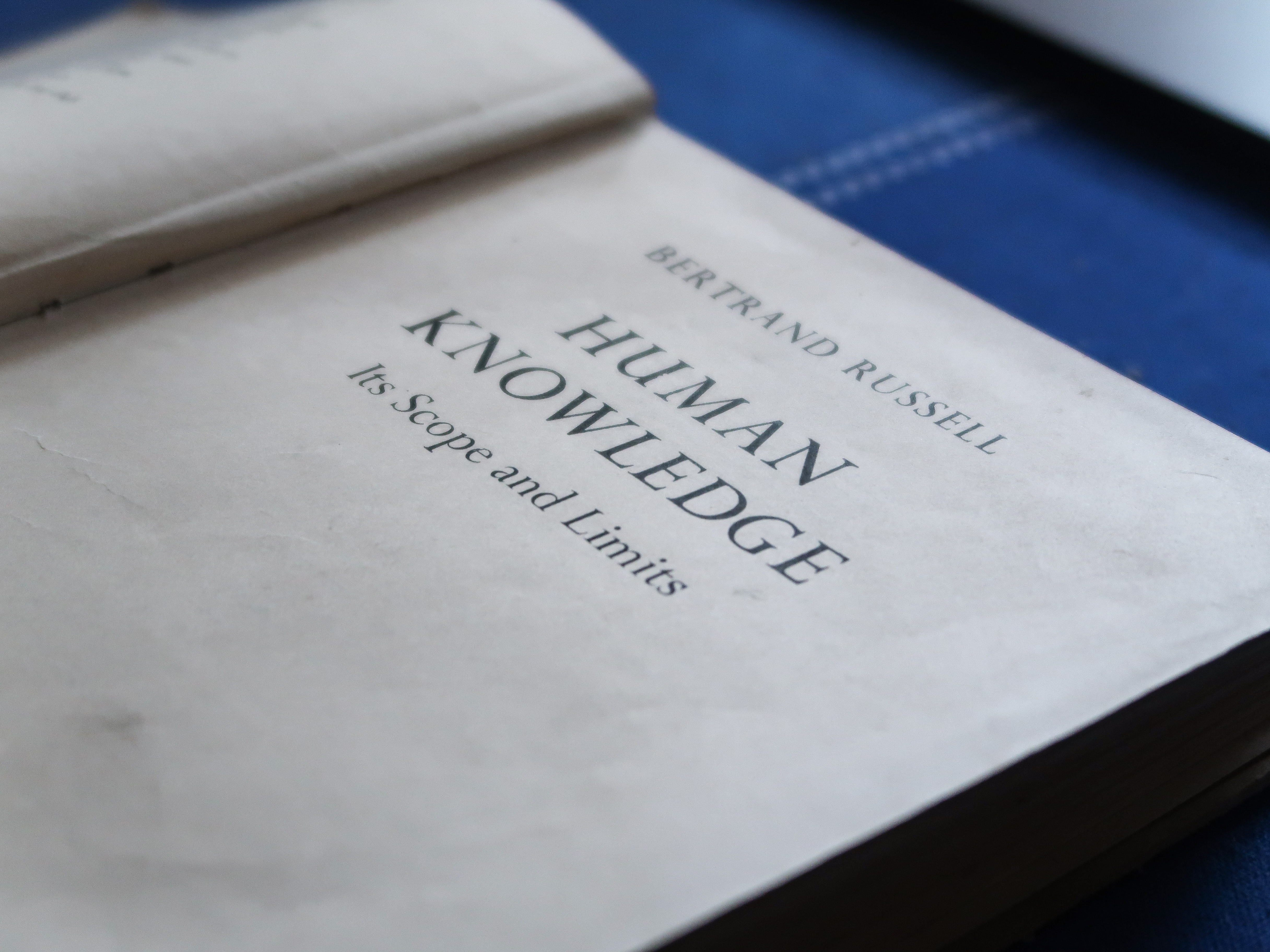
Human Knowledge: Its Scope and Limits is a 1948 book by the English philosopher and mathematician Bertrand Russell. It is a dive into the epistemological accounts of what we claim as knowledge, the means for obtaining it, and its validity. Russell presents the work as a more accessible piece to the public that focuses on the thought, yet if you thought that it is a cake ride through the forests of meta-knowledge, you would be wrong. Your consolence is just on the stepping stones that the author has paved, mainly using relatable examples that bring his point across. I found myself stumbling down in Part-V of the book, where he discusses the validity of the theory of probability in and out of itself and as a tool in our scientific explorations, but was happy to come out of it with refined thoughts about the whole business.
The book is divided into 6 parts, and we are going to discuss them in that order:
Part-I: The World of Science
Part-I begins with the sciences and provides a historical account of the evolution of physics, astronomy and biology. At the end, it reaches the psychological aspect of things, and what I felt was a casual lie-down of 2 phenomena: sensations and volitions, laid by Russell in an attempt to explain this-sensations starting from outside the body to inside and volitions the other way around. The ball is still in the court of the sciences, but I felt Russell to be shying away from a materialistic explanation, so on either side you are on regarding the latter theory, Bertrand has set a neutral rung for expansion in further parts, like Part-IV.
Part-II: Language:
Language is both a medium for the communication of knowledge and knowledge in itself. We need to reduce language back to its origins, to how a baby might learn it, and in this process, we end up learning a lot about our knowledge itself. At the edge of the spectrum, you have words that can be defined in terms of other words: this is what makes a dictionary useful; but when you move into the line, you ultimately end up with words at the base that can only be defined ostensively. The objects of understanding indicated by a word for you as a demonstrator and for a demonstree, eg. a baby may/may not be different; but suppose you follow J.S. Mill's canons of induction- through the postulates that Russell later lays in Part V, one can analogize a common reference. You might have detected your first taste of uncertainty now, and that is something that you will realize to be the constant present the more you get through the book. But coming back, as you reduce words, you eventually come to the question of reducing syntax words: words like 'all', 'some', 'not', etc. Something which I found interesting is Russell's motive in reduncting the word 'not', which is astonishing for a person who's gone through a course in logic. The way he does this is by bringing the concept of belief- then the word 'true' is believing in a sentence, and the word 'false' is disbelieving in it. In both cases, there is an instinct that identifies a positive element of the sentence, hence Russell classifies both of them as positive predicates. The words 'all' and 'some' can also be reduced through positive and negative enumerations- I feel this becomes crystal after reading through Part-V. If there is a propositional function which takes in values to form statements(propositions), 'all' is a disbelief in a negative propositional function for all values, and 'some' is a belief in a positive propositional function for at least 1 value. But in Part-II, without any of the mathematics, the base lies in a concept: 'this'. I feel it is the cursor for the entire book. It is the substance that you refer to at any point in space-time. Enumerative statements can be laid in terms of 'this' then.
Part-III: Science and Perception:
We have the terminology sorted for our search, but now we need a method to begin. Scientific inquiry starts and continues with perceptions. And percepts involve the mind. There's the idea of solipsism- that your mind is the only thing that exists, but Russell spends a chapter on this to show how you cannot be sure of your own existence if you take that to heart. You and your history could have been placed 5 minutes before your conception, filled with memory, and you would still think your mind to be a veridical authority. The only truthful way you can take solipsism is to even distrust your past, in which case, no progression can be made scientifically. Russell prefers to not take this route. He explores the ideas of time and space through percepts, and how they stand next to objective space and time. To summarize this, your visual percept includes all of your perceptual experiences, but it is regardless correlated with a physical point in space; and your perceptual time is non-linear, and when you 'remember', the action that you hope takes you to the past is in the present, and is not a noiseless process, yet we need a postulate to correlate it with reality. The mind can never ascertain the verity of the matter, for even the observations end in mental events. Yet, we can infer similarity of structure from the fact that the thought is but an end inside the brain that originated from a physical event in space-time.
Part-IV: Scientific Concepts:
How do you define space, and time? We can use dates for time and latitude and longitude for space(at least within the Earth, celestial coordinates otherwise); but if you notice, these are defined relative to an epoch or a reference. We can, of course, forgive that, but what matters here is not the system; it's the fundamental question about what their granularities are. Newton's system called for time as only an undefined variable, but if you take relativity, space and time are defined in terms of events. So, what is an instant and what is an event?
Russell defines an event as something that happens in an instant of time-not completely, but at least partially. An instant, in space, and in time, is the conjunction of all events that overlap such that no other event overlaps with all of the events that form the conjunction. In the previous chapter, an instant is defined to be a complex of compresence of qualities. Then, in my understanding, we have to consider an event as a collection of such complexes, which itself could be a complex. So what do I mean by a complex of compresence? If you arrange the qualities in your experience in space-time in a class, you can call this class as 'this' instant in space-time. Nothing is exempt from 'this' if you take space-time as a whole(instead of space and time). You can define your particulars with proper nouns, but I say 'this' yet remains ostensive.
Part-V: Probability:
Probably the hardest part for me to go through, partly due to time constraints and partly the mathematics which can interest one to verify the factorials. But I was eager to go through this, because yonder since the time of having learnt probability, I've had thoughts about it's verity. Russell, I think, stands on the side which I more or less call home. He begins with Bishop Butler's famous saying, 'Probability is the very guide to life'. The mathematical theory of probability is basically enumerative; what lends it a predictive sense are extra-logical axioms. Bertrand goes through the theories developed in that regard. You can see how he pushes in each theory with his stamp of belief: the Mises-Reichenbach theory- that claimed probability is but the limit of the ratio of positive outcomes in a series(not a sequence) as the number of elements in that class tended to infinity; and Keynes' approach- towards defining probability as relations on propositions through giving it a degree of credibility. He corrects Keynes' theory to include for propositional functions instead of just propositions, and asks of Reichenback of the impractical sample sizes that one would have to take to verify the ratio. It can always be the (N+1)th term in a series that breaks the pattern. Russell says that if inference is to be made, then your classes will have to be defined intensionally rather than extensionally. By the end of the section, what you see is a disappointed philosopher who has yet not found his reasoning to believe in induction. In any reasoning procedure, you have inwardly tending layers of inferences. Your original proposition has a degree of credibility, but there is also needed a degree of credibility for that previous statement giving the original proposition it's credibility. It leads to an endless regress. Reichenbach terminates it by using blind posits and crashing it at some point. But you have to assume the degree of credibility that would account for all the layers you didn't go through. This is often not numerically given. There is no right place to stop, so if you keep it going, you reach a limit of fractions that tend rather to 0 if not a limit, which you cannot calculate.
But one thing is clear: probability is the way you give a degree of credibility, numerical or otherwise(more explored in Keynes' theory), to a scientific inference. So you need to give validity for the use of induction.
Part-VI: Postulates of Scientific Inference
This is more of an extension to Part-V and a summary of the entire book, but it gives a conclusion to the ride we have been through, something which I have a bit of downer with. If you finally wanted an idea of 'knowledge', it's beliefs. Animals have beliefs from habits-it turns to expectations-and when those expectations have been verified, it counts as knowledge. The verification of these beliefs has been our ordeal. Russell verifies knowledge through seperable causal lines: connected through the idea of quasi-permanence, the lines that can redefine substance and identity, and things, which are just series of events(more in Part-II). The complement is analogy, which completes the extra-logical argument: closer to our naive idea of causal antecedents to the same percept. All of this gives the inference a degree of credibility. Russell agrees with the view that theories can, after all, be infinite for the same set of observations; only the future can rebuke that. I think that analogy can be restated in terms of causal lines, for if we are completely in that causal chain, our volitions are also then included in it. And mostly, I feel the conclusion is but the end of an exploration that starts off to great magnitudes to reach a more mundane terminal; not that I disagree with the thought, but I felt that Russell didn't heavily attempt rebuking these postulates in light of the parts he had gone explaining, in contrast to theories like the postulate of natural kinds(limited variety as he calls it) by Keynes, which, by the way, is a quick dive for reductionism. I would have liked, however, for a deeper dive into this domain, for one of the limits that we see in our knowledge is where the subatomicity stops.
This leads me to a criticism which I find in this work: his relative sidelining of scientific and mathematical theories compared to his gorgeous dives at epistemology in other terms. It is niche, because to encompass epistemology in all of its concerns, it will not suffice for a 500-page book, but rather manuals with multiple volumes. Regardless, I state this: I felt Russell to sideline logical principles as somewhat impermeable to human error, yet in the history of mathematical philosophy, we know even these can be refuted. Whether mathematics was created/discovered, it's like the religious books; it came through us at some point, in this case, through conception, so, shouldn't we attach degrees of credibility to that? Same with scientific theories: the whole idea of reductionism, etc. but here it is more forgivable since this book is more of a tool to justify our tools rather than define the world- that is ontology, gentlemen.
To get into more remarks:
- The whole work acknowledges the differences in our experiences, and by that regard, I felt it was not acknowledged enough in his chapter on Analogy, where we know for a fact where our perceptions are so very different from the same stimulus. Russell claims structures(eg. a voice) to remain the same as it passes through the environment, though the process modifies due to abruptions and interference. But he did not consider how these changes can be so drastic that when they are sensed, they seem as 2 different structures. In other words, where is the percipient in the causal chain? as I previously mentioned.
-
There is this chapter in Part-VI Chapter IV: 'Knowledge transcending Experience' where Bertrand refutes logical positivism for reasons including their idea of verification. He starts with laying out how verifiability is bogus if we obtain a positive result only for an extended class but generalize it to a base class. If we were to use intensional definitions as per Part-V, the only way this can arise is if we frankly don't know in what respect the base class differs from the extended class, I say. The writer is fine with scientific theories based on verification in the chapter of 'Interaction', and as long as you leave room for falsifiability(when you do detect where the base class differs), it should be fine in my view, but this seems at least contradictory in the writer's principle. His idea of verification never being able to support ideas which we never can't support to not happen, eg. the fact that there should be places we don't know where it rains, or that there exists iron in the core of the earth are substantial. But when he says that verification, as a social matter should reject the idea of meaning with it, I was at odds; obviously with respect to the above fact, this makes more sense, but the writer relates this to peoples' minds: the fact that if we were to accept their testimony, we have to accept them, but whether or not you accept their reality, your perception gives the same verifiable consequences; hence to accept them means to disentangle the relation of meaning with verification, which for me is just the writer's rephrasal of his escape from solipsism...when you can just admit their presence through induction, noting the fact here that we are only concerned with this idea and not finding grounds for induction at the moment. Verification is a social matter, the author says, yet even when he uses the term in 'verifiable consequences' on Pg. 467, he uses it in a solipsist vs non-solipsist comparison-when verification if social, as he says, should be non-solipsist, unless it's a looped universe where the universe and our perceptions are simulations.
In the modern age, I can go even beyond solipsism: reject even Descartes and question my own existence. What if it is a simulation? How would you gauge your knowledge then? Does it matter? All these questions. - Finally, I wanted to talk about the Principle of Indifference as put by Keynes, explained by Russell. On Pg. 260, there is the construction of groups with qualities such that if 2 qualities are in the same group, they have the same extension. If you take that to taxonomy, it's easy to see why that wouldn't make sense. Sometimes a species is differentiated from another in terms of more than 2 qualities. This also makes me propose the idea of a quality not being restricted to just 1 group, which I don't think was the original idea. It is just this intersection of qualities that should create this common extension, which I can get behind. And if you are taking groups, go from genus to species in this procedure for eg., what would restrict us from taking this to psychological levels? This is then a textbook classification problem.
'Human Knowledge: Its Scope and Limits' is an enlightenment to thinking about scientific enquiry, which is beyond what you think as the professional sciences and more towards it's fundamental definition: that of rational and falsifiable thought. Russell does not lead with theory to become incomphrehensible, he gets his point across through examples; he doesn't seem to be after completely unpragmatic wisdom: this we know from his rejection of solipsism. It is a good guide for someone who would be hearted at having to check to the roots and around what and how we know and should know.